
Knee Pain in Your 30s and Back Pain in Young Adults: Why It Starts Earlier
Knee pain in your 30s can feel far too early. The same is true of lower back pain in your 20s or 30s, especially when it returns after work, exercise or a long drive. However, pain at this age does not automatically mean that your joints are “worn out”. In many young adults, it reflects a mismatch between what the body is being asked to do and what it is currently ready to handle.
A World Bone & Joint Day report on 4 August 2026 drew attention to persistent knee pain, back pain and early cartilage problems among adults in their 20s to 40s. The concern is timely. Bone and Joint Health Action Week, held from 12 to 20 October, gives us another reason to discuss what these symptoms mean. More importantly, this is useful all year round because early action is often simpler than waiting until pain controls work, sleep or sport.
Why Joint Pain in Young Adults Is Showing Up Earlier
There is rarely one cause. Instead, several small factors may build up over months or years.
- Long periods of sitting. Office work, commuting, gaming and scrolling can reduce how often the hips, knees and spine move through different positions.
- Too little strength work. When the muscles around the hips, thighs and trunk are not prepared, ordinary tasks or sport can feel like a much larger load.
- A sudden jump in exercise. A new running plan, padel tournament, long hike or intense gym challenge can overload a tendon or joint before it has adapted.
- Body weight. If weight has increased, the knees may need to manage more force during stairs, squats and running. Weight is one factor, not a judgement or a complete diagnosis.
- Previous injury. An old ligament tear, meniscus injury, fracture or operation can change the future risk of early onset arthritis.
- Recovery that does not match the load. Poor sleep, repeated hard sessions and too few rest days can make pain more likely to persist.
Screen time itself does not scrape away cartilage. However, it can replace movement, sleep and exercise. Similarly, one imperfect sitting position does not ruin the spine. The more useful goal is to avoid staying fixed for too long and to build the capacity to handle work and leisure.
Knee Pain in Your 30s: Common Patterns
Knee pain young adults experience is not always arthritis. The location, trigger and behaviour of the pain often give better clues than age alone.
| Pain pattern | Possible source | Common clues |
|---|---|---|
| Around or behind the kneecap | Patellofemoral pain | Worse with stairs, squats, hills or sitting with the knee bent |
| Just below the kneecap | Patellar tendon overload | Linked to running, jumping or a rapid increase in sport |
| Along the inner or outer joint line | Meniscus or joint irritation | May follow a twist and cause swelling, catching or locking |
| Pain after a pop or giving way | Ligament injury | Instability, rapid swelling or difficulty continuing the activity |
| Gradual ache, swelling and stiffness | Early joint change or inflammation | Persistent symptoms, reduced movement or pain that affects daily tasks |
These patterns overlap. For example, pain at the front of the knee may come from the kneecap joint, a tendon, a fat pad or nearby soft tissue. Therefore, a proper examination matters when symptoms persist.
Back Pain from an Office Job: Is Posture to Blame?
The World Health Organization notes that about 90% of low back pain is non-specific. This means that no single disease or damaged structure fully explains the pain. Low physical activity, obesity, smoking and high physical stress at work are recognised risk factors.
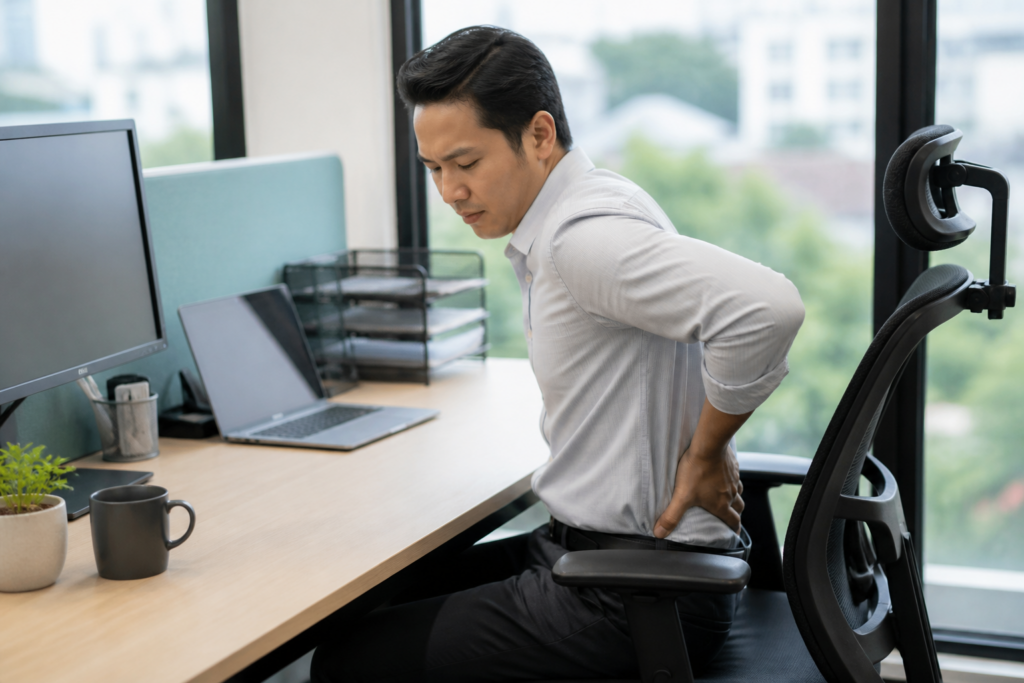
A back pain office job pattern often develops after long, uninterrupted sitting. The back may feel stiff when standing up, yet improve after walking. A poorly arranged workstation can add strain. However, posture is not a simple good-or-bad test. Even an upright posture can become uncomfortable when held for hours.
Try to make the workstation fit you. Keep the screen at a comfortable height, support the feet and bring the keyboard close enough that you do not have to reach. Then change position often. Short walking or movement breaks throughout the day usually matter more than sitting rigidly.
Does Pain Mean Early Cartilage Degeneration?
Not necessarily. Cartilage is the smooth tissue that covers the ends of bones inside a joint. It has very few pain-sensing nerves. Therefore, pain can come from the bone beneath it, the joint lining, meniscus, tendons, muscles or other tissues around the knee.
The US National Institute of Arthritis and Musculoskeletal and Skin Diseases explains that osteoarthritis affects the whole joint and is not simply caused by normal “wear and tear”. It is more common with age. In younger people, it is more likely after a joint injury, an unusual joint shape or a genetic cartilage problem. Extra body weight and repeated joint overuse can also increase risk.
Possible cartilage damage symptoms or early osteoarthritis features include:
- Pain with weight-bearing activity that becomes more frequent over time.
- Swelling after activity or repeated swelling without a clear reason.
- Stiffness after rest, usually for a short period.
- Loss of knee movement.
- Catching, locking or a feeling that the knee may give way.
- Increasing difficulty with stairs, squats or walking.
However, none of these proves that cartilage is damaged. Painless clicking is also common and does not, by itself, mean early onset arthritis. Symptoms, examination and suitable imaging must be considered together.
Normal Ache or a Sign That You Need an Assessment?
| Often settles with simple care | Arrange an assessment | Seek prompt or urgent care |
|---|---|---|
| Mild muscle ache after unfamiliar activity | Pain that persists, keeps returning or is worsening | A knee that rapidly swells, locks or cannot bear weight |
| Symptoms improve within a few days | Pain that changes how you walk, work, sleep or exercise | A major injury, obvious deformity or a painful pop with instability |
| No swelling, weakness or loss of movement | Repeated swelling, reduced movement or giving way | Fever, marked redness or a hot, swollen joint |
| Comfortable daily activity remains possible | Back pain with leg pain, tingling or numbness that is not settling | New bladder or bowel trouble, numbness around the groin, or increasing leg weakness |
Back pain with unexplained weight loss, fever, a history of cancer, significant trauma or pain that is severe and unrelenting also needs medical review. These warning signs do not always mean a serious condition, but they should not be ignored.
When Does Knee or Back Pain Need Imaging?
Not every painful joint needs an immediate scan. Imaging is most useful when the result may confirm a suspected diagnosis, rule out an important problem or change treatment.
For persistent knee pain, an X-ray is often the first image. Current American College of Radiology guidance rates knee radiographs as the usual initial study for chronic knee pain. MRI may be the next step when the X-ray is normal or shows joint fluid and the examination suggests a meniscus, ligament, cartilage or other soft-tissue problem. An MRI is not automatically the best first test.
For uncomplicated lower back pain, early imaging often does not improve care. NICE guidance advises against routine imaging for low back pain with or without sciatica. An orthopaedic surgeon may recommend an X-ray or MRI if there are warning signs, worsening nerve symptoms, significant trauma, persistent symptoms that need further investigation, or if the result is likely to change treatment.
A scan must match the person. Imaging can show changes in people who have no pain, while a very painful knee or back may have only small changes on a scan. For this reason, the history and physical examination come first.
What You Can Do Before Pain Becomes Persistent
The aim is not to avoid movement. It is to make activity and recovery more balanced. The following steps are general and may not suit every condition.
- Break up sitting time. Stand, walk or change position regularly. A brief movement break is easier to repeat than one long stretch at the end of the day.
- Build strength gradually. Strengthen the thighs, hips, calves and trunk two or more times a week if this is comfortable and appropriate for you.
- Increase sport in small steps. Avoid raising distance, speed, weights and training days all at once. Give the body time to adapt.
- Keep some comfortable activity. Complete rest can reduce strength and confidence. Walking, cycling, swimming or modified exercise may be suitable, depending on the cause of pain.
- Review technique and equipment. Workstation set-up, running form, shoes and gym technique can matter, especially after a recent change.
- Support recovery. Sleep, rest days, food and hydration all help the body respond to training and work demands.
- Address weight without crash diets. If weight is contributing to knee symptoms, steady, realistic changes can reduce joint load and support overall health.
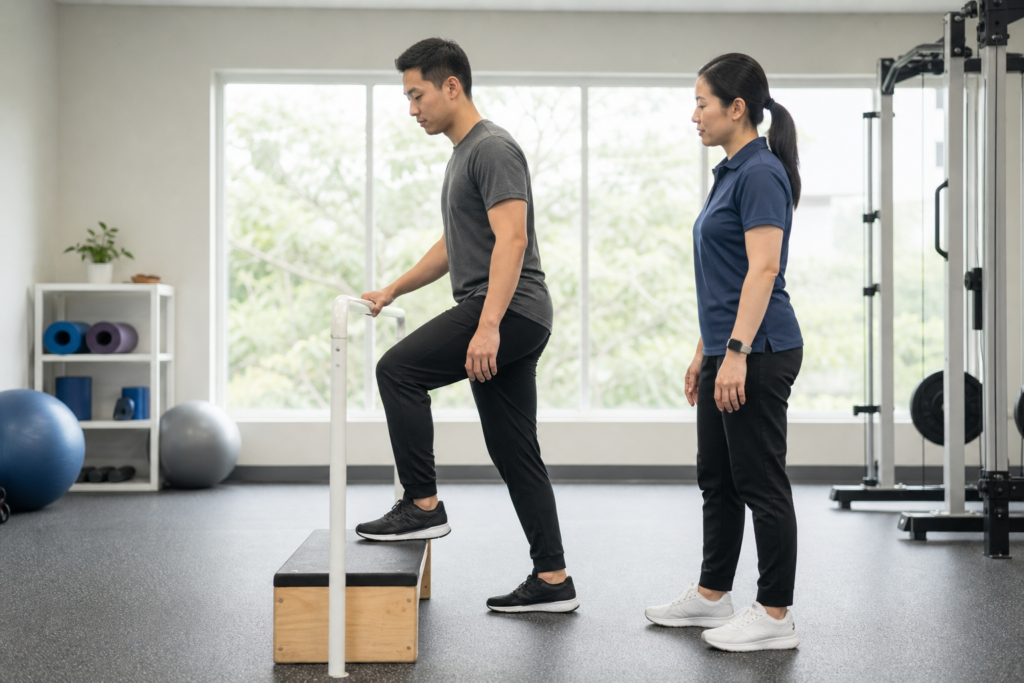
Sport is not the enemy of cartilage. Well-planned movement supports strength, fitness and joint health. The more common problem is doing too much, too soon, after a period of low activity or returning to sport before an earlier injury has recovered.
When to See an Orthopaedic Surgeon
If you are wondering when to see an orthopaedic surgeon, focus on the behaviour of the symptoms rather than your age alone. Arrange a consultation if knee or back pain lasts for several weeks, keeps returning, is getting worse, or limits work, sleep, walking or exercise. You should also seek an assessment after a significant injury, or if you have swelling, locking, instability, reduced movement, weakness, numbness or pain spreading down the leg.
An orthopaedic surgeon can examine the joint or spine, identify whether the problem appears mechanical, inflammatory or nerve-related, and decide if imaging is needed. Many causes of joint pain young adults experience improve without surgery. A clear diagnosis, sensible load changes and a progressive rehabilitation plan are often the starting points.
Conclusion
Knee pain in your 30s and back pain in young adults are not automatically signs of an ageing body. Long sitting, low physical capacity, sudden sports load, body weight, poor recovery and previous injury can all contribute. Early onset arthritis is possible, especially after joint injury, but pain alone cannot confirm cartilage damage.
Start by varying your position, building strength and increasing activity gradually. Then pay attention to the trend. Mild aches that improve are different from persistent pain, repeated swelling, locking, instability or nerve symptoms. If symptoms are severe, recurring or affecting daily life, consult an orthopaedic surgeon for an individual assessment and the right imaging, if any.

Contact & Request Appointment
Schedule a consultation by using the form below, or calling her clinic or using the online booking button.
Please note that consultation is ONLY by appointment – no walk-ins.
Appointment Form 🇲🇾
NOTE: To avoid disappointment with walk-ins patients and same day appointments requests, proper appointment is necessary as the doctor may not be available all the time in clinic as she may be performing surgery.
Clinic Contact
7B-07, Level 7, Sunway Medical Centre Velocity,
Lingkaran Sunway Velocity, Sunway Velocity,
55100 Kuala Lumpur, Malaysia 🇲🇾
Mon & Fri: 10:30 – 12:30
Tue & Wed: 10:30 – 16:30
Sat: 9:00 – 12:30
Thu & Sun: Closed
L5-36, Sunway Medical Centre Damansara,
No. 2, Jalan PJU 5/1a, Kota Damansara, PJU 5,
47810 Petaling Jaya, Selangor Darul Ehsan, Malaysia 🇲🇾
Mon & Fri: 14:00 – 17:00
(by appointment only)

